This website uses cookies
This website uses cookies. For further information on how we use cookies you can read our Privacy and Cookie notice

This website uses cookies. For further information on how we use cookies you can read our Privacy and Cookie notice


Free return within 15 days for all eligible items.Details
Newton Books
90%Seller Score
198 Followers
Shipping speed: Excellent
Quality Score: Excellent
Customer Rating: Good
Cancellation Rate: Good
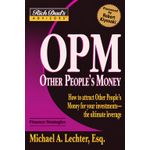
Rich Dad’s Advisors: OPM: How to Attract Other People’s Money for Your Investments
By Michael A. Lechter
Understanding how to fund an opportunity is an important part of learning how to invest or build a business. In Rich Dad’s Advisors: OPM, Michael A. Lechter explores how people can look beyond their own savings when seeking capital. The book examines how to attract outside funding, evaluate different sources of money, and bring investors into a business while considering the ownership involved. It connects financial education with the practical question of how to obtain the resources an opportunity requires.
What does OPM mean?
OPM stands for other people’s money. In this context, it means using capital supplied by others to help finance a business or investment. Lechter’s approach also includes other people’s resources, or OPR: accessing resources or services through arrangements with others instead of first raising cash to purchase everything yourself.
This distinction encourages a useful change in perspective. Alongside asking how much money you need, consider what resources you actually require and who could contribute them. In his own explanation of the approach, Lechter distinguishes borrowing from selling an ownership interest and describes how resource contributions can offer another route. Each arrangement involves something in return, so understanding its cost and terms matters.
A closer look at raising capital
The book moves from funding choices and preparation to specific sources of capital. Topics include debt and equity, deciding when and how much money to raise, and gaining access to potential funders. Dedicated chapters address friends and family, angel investors, venture capital, institutional lenders, factoring and leasing. Other sections cover joint ventures, licensing, strategic alliances, grants and an introduction to securities laws. This gives the book a substantial entrepreneurship and business-financing focus. Published table of contents
If your questions concern how a venture might obtain investment capital, what funding routes exist or how outside participation could affect ownership, OPM addresses the territory you want to understand. It can also provide a starting point for identifying questions to investigate more deeply before discussing financing with potential partners.
Who would benefit from reading it?
This book is particularly relevant to aspiring entrepreneurs, business owners exploring funding and readers interested in the financing side of wealth building. Students of business and personal finance may also appreciate a title that connects investment ambitions with capital acquisition.
Readers interested in real estate investing can approach it as broader financial education. Its business-funding emphasis makes it most useful when your question concerns access to capital and resources; readers seeking property-specific analysis should pair it with a dedicated real estate book.
For readers in Ghana, OPM offers a focused subject to add to a business and investment reading plan. Its value lies in developing understanding and better questions.
Order now from Newton Bookshop and have it delivered to your doorstep.

This product has no ratings yet.